Role
Impact
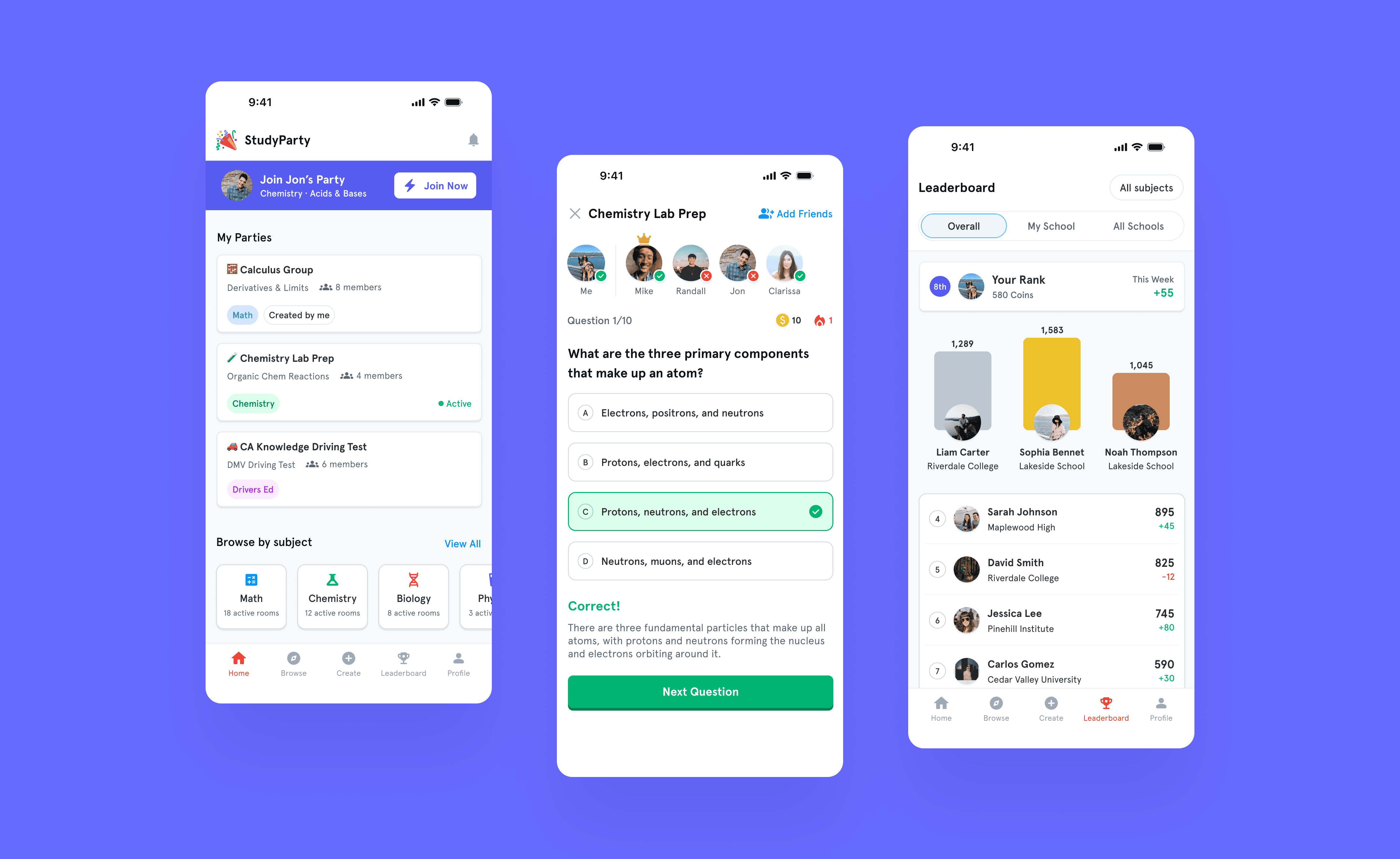
Overview
Numerade’s platform had successfully built a massive learning ecosystem around homework help and AI tutoring. However, the experience remained largely solo. Students could watch explanations, upload problems, or chat with AI, but the platform lacked a fun, social learning layer that encouraged collaborative studying.
Study Party was designed to introduce synchronous low pressure study sessions that made learning feel social without forcing participation.
The goal was to shift students from passive consumption to active, shared learning experiences.
Led the end-to-end product design for Study Party, translating behavioral insights into a lightweight real time social study experience. Because Study Party functioned as a distinct product layer within Numerade, I designed both the interaction model and a dedicated visual system that differentiated the experience while still integrating with the broader platform.
• Defined the product experience and interaction strategy for real time study sessions
• Synthesized research insights and translated them into design principles for social learning
• Designed the full user journey from discovery to joining to participating & repeat engagement
• Built a distinct visual identity and component system for Study Party, separate from Numerade’s core product UI
• Created reusable UI components and states for rooms, reactions, study timers, leaderboards, and presence indicators
• Scoped the MVP with PM and engineering to balance engagement goals with engineering constraints
• Rapidly iterated on the experience based on behavioral data and user feedback after launch
Increase participation in collaborative learning
How might we help students study together without creating social pressure or awkwardness?
Reduce friction at the point of entry
How might we make joining a study session feel as easy as clicking play on a video?
Encourage longer study sessions
How might we create an environment that motivates students to stay focused and engaged?
Support different study styles
How might we accommodate both social learners and students who simply want quiet accountability?
Small Design team
We needed to move quickly and validate the concept early.
Limited engineering bandwidth
The solution needed to work within Numerade’s existing infrastructure.
Unproven feature category
Social learning was new for the platform, so the MVP had to demonstrate value quickly.
Risk of building a Discord clone
We needed to avoid creating a complex community platform that would slow development and moderation.
Research Inputs

• Drop off patterns during AI sessions
• Social feature engagement data
• Time of day study trends
• Exit surveys
• 1:1 student interviews
Insight
Design Implication
Students want community, but fear awkwardness.
Low Pressure participation and passive presence options
Students didn’t want rigid commitments.
Instant drop-in access
Empty rooms felt discouraging.
Visible activity and momentum
Many students wanted quiet accountability.
Reduced friction at entry
Key Observations
Many existing platforms leaned heavily toward:
• feature depth
• public visibility
• structured participation
Live Sessions often felt
• performative
• scheduled
• socially demanding
Students frequently had to navigate complexity before they could actually start studying.
Strategic Design Direction
Rather than replicate community platforms, I focused on designing a low friction study environment.
Key priorities included
• instant access
• visible activity
• lightweight interaction
The goal was not to build a social network, but to make studying together feel effortless.
Reducing Friction to Join
Why?
Interest was high, but many students dropped off before entering a room.
Design Decisions
• Instant join rooms
• Auto generated topics
• Visible participant count
• Clear active status indicators
Tradeoff
We sacrificed deeper customization early on to prioritize speed to entry.
Lowering Social Anxiety
Why?
Students wanted accountability without feeling forced to interact.
Design Decisions
• Quiet mode rooms
• Optional video and audio
• Lightweight emoji reactions
• Behavioral cues in UI copy
Tradeoff
We limited expressive social features like DMs or detailed profiles to reduce complexity and moderation overhead.
Increasing Engagement Time
Why?
Joining a room wasn’t enough, students needed reasons to stay.
Design Decisions
• Study timers
• Visible streaks
• Micro interactions like reactions and prompts
Tradeoff
We intentionally avoided heavy gamification until core behaviors were validated.
Video Felt intimidating
Students were hesitant to join video calls with strangers.
What changed?
• Full control over video and audio
• Participation became optional
• Introduced avatars, reactions, and chat
Impact
Lowered social pressure and increased comfort during entry.
High Drop off
Nearly 50% of users exited shortly after entering a room
What changed?
• Displayed a study question immediately
• Allowed users to shuffle between rooms
Impact
Improved join completion by 22%.
Not Everyone wanted to chat
Many students preferred quiet accountability rather than conversation.
What changed?
• Introduced asynchronous-first study flow
• Social interaction became optional
Impact
Average session duration increased 18%.
Main Screens
Home
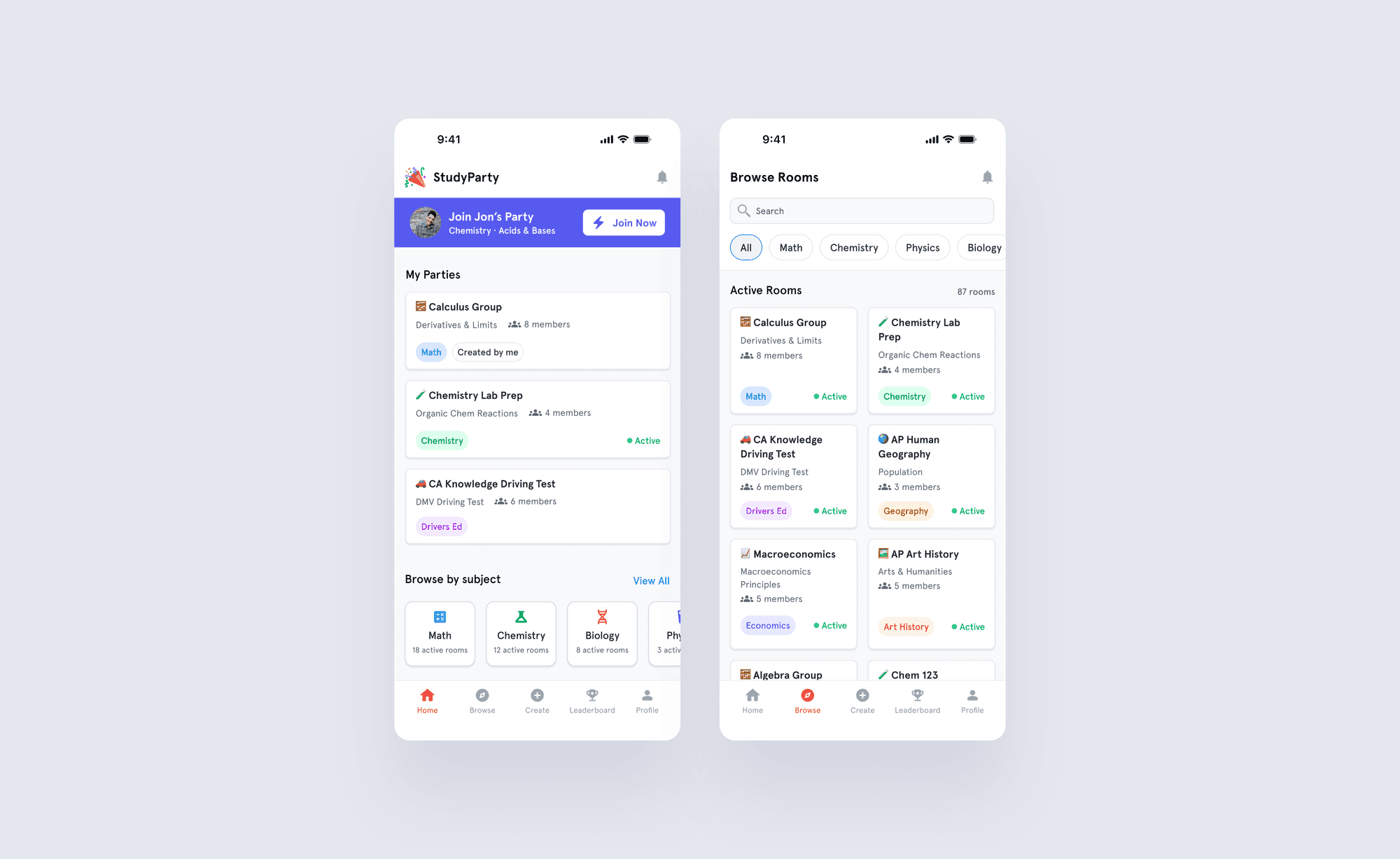
Students can instantly join active study parties or sessions created by friends. The focus is speed and momentum and minimizing the steps between intent and participation.
Browse
Students can explore study parties by subject or activity. While Home prioritizes speed, Browse supports discovery.
Joining a party
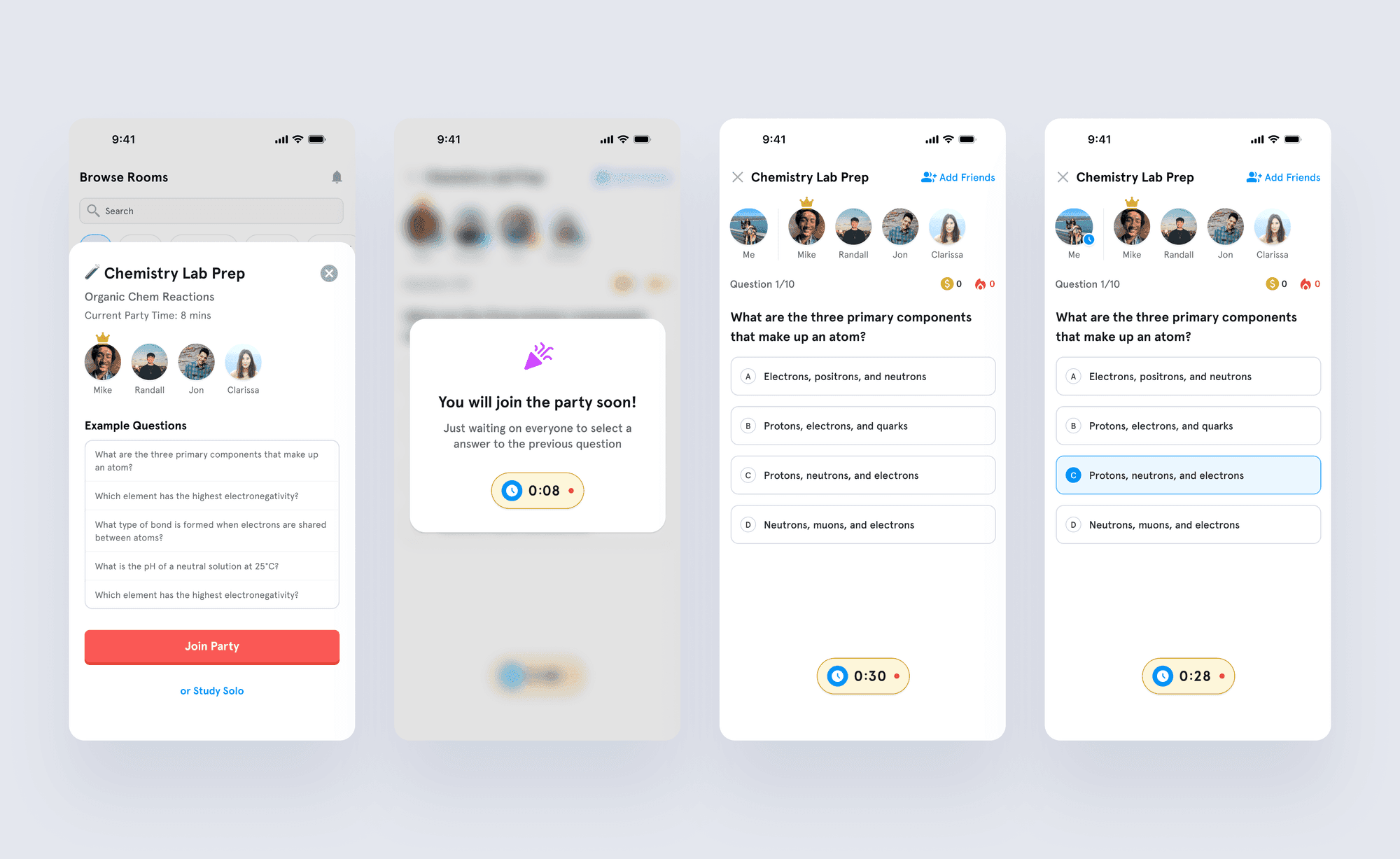
Before Joining
Students see the topic, participants, format, and time in the current study block, so they know what they’re walking into. Multiple choice quiz mode creates an engaging, low-pressure way to test knowledge as a group.
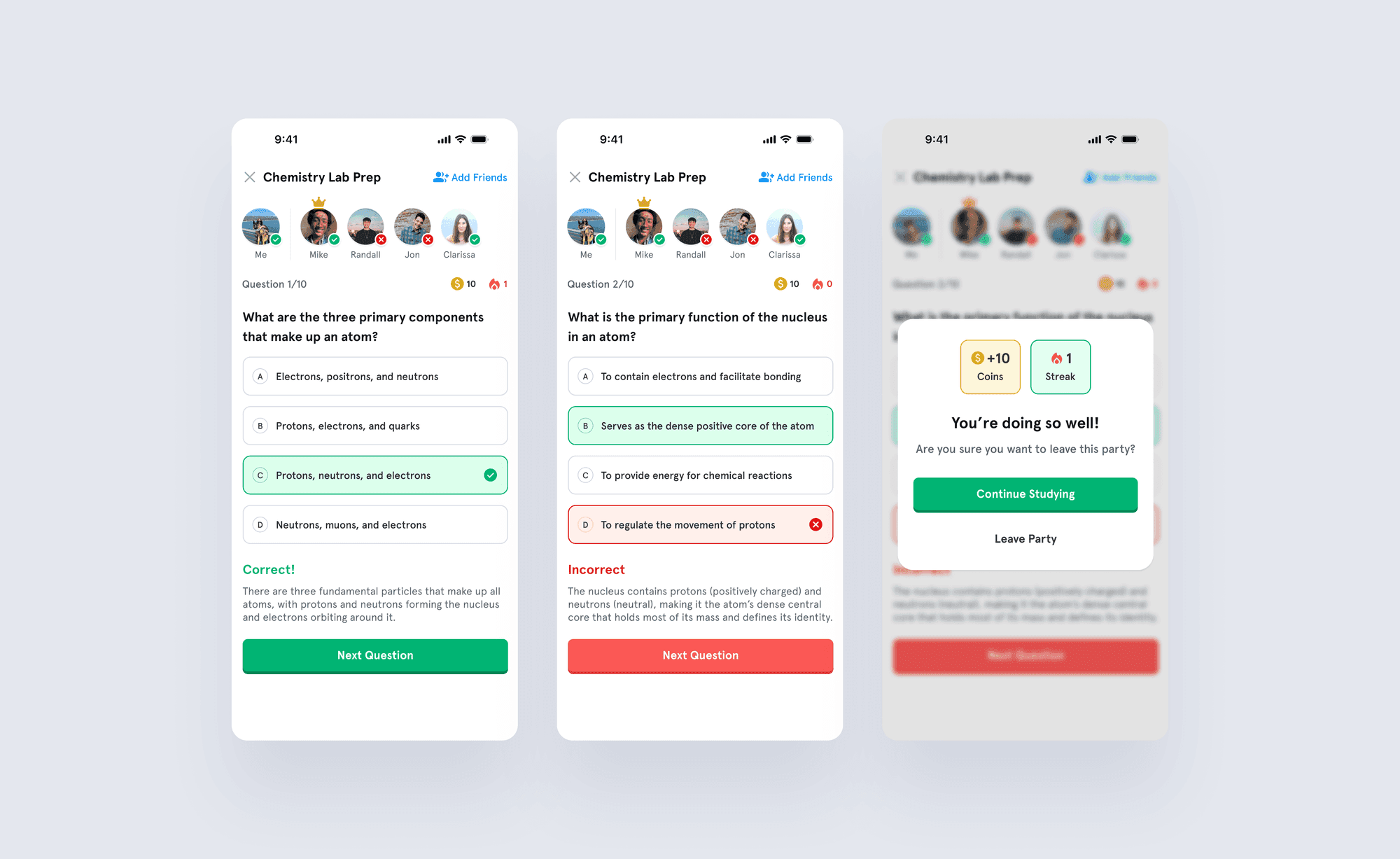
Inside the party
The experience prioritizes presence without pressure. Students interact through avatars, chat, reactions and quiz participation. Shared topics keep everyone aligned while maintaining flexibility in how they participate.
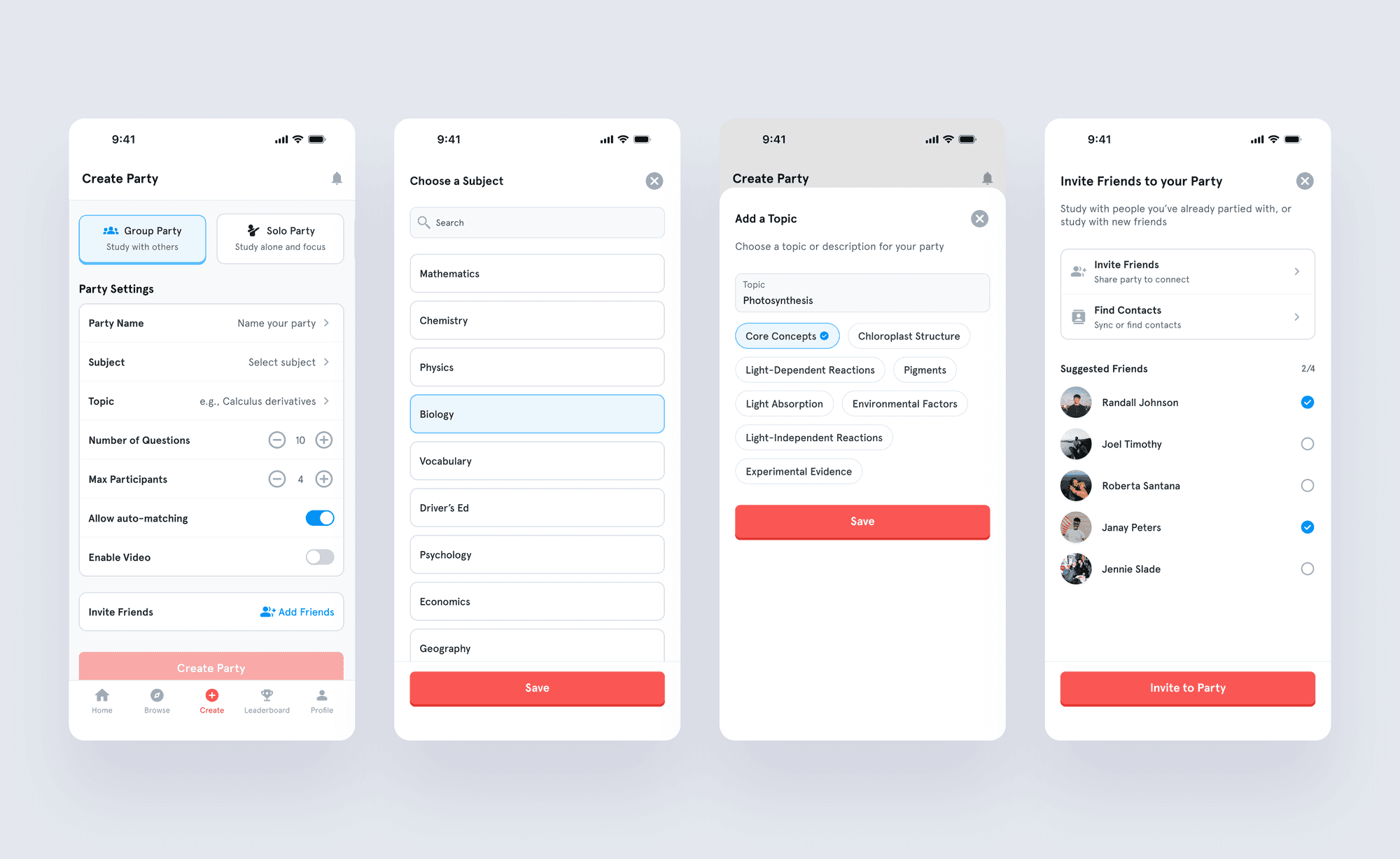
Creating a party
Solo Party
A personal accountability session using timers and streaks.
Group Party
A collaborative session where friends or classmates can join.
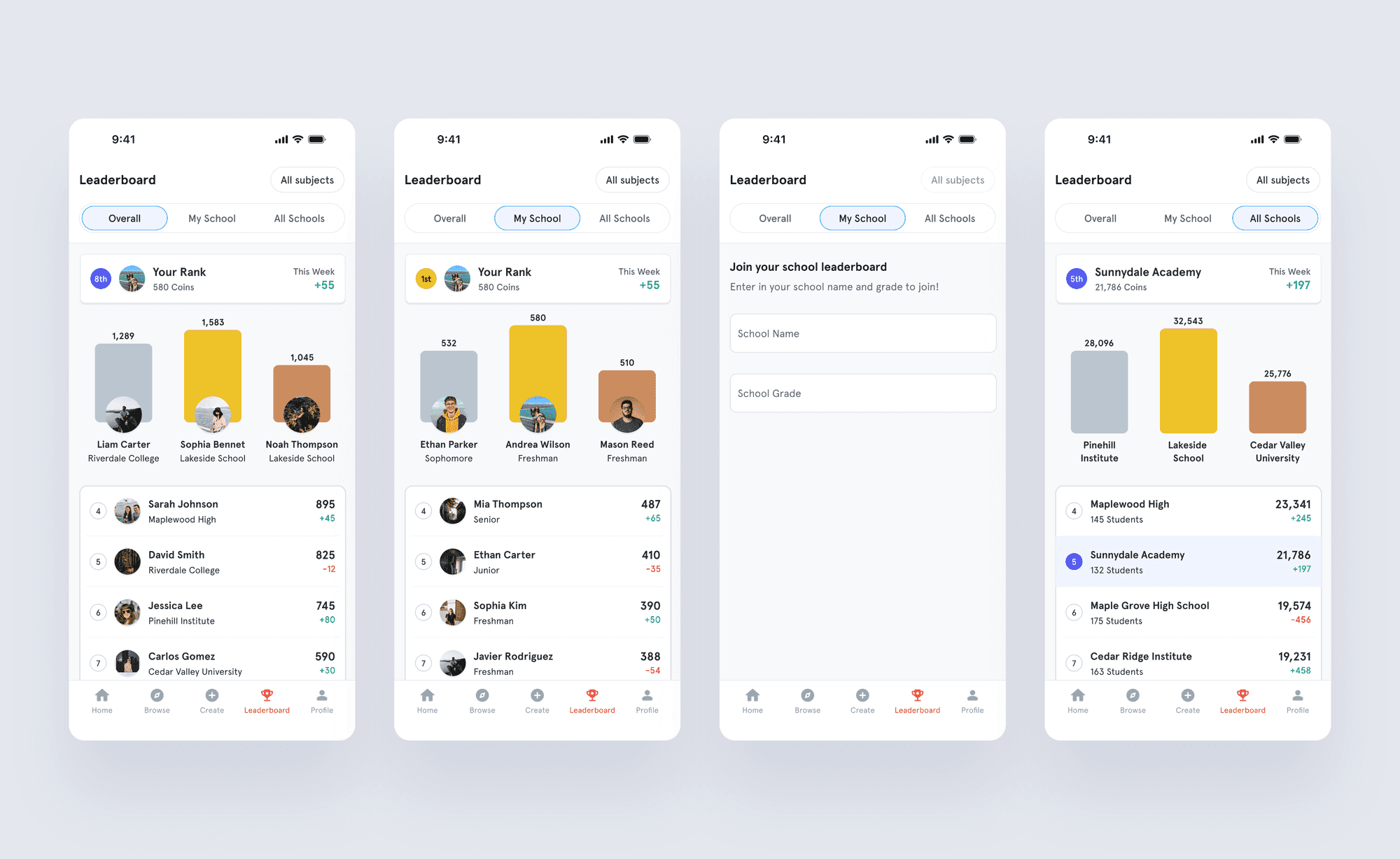
Leaderboards
Leaderboards introduced friendly competition across three levels. There is global rankings, school rankings and a inter-school competition. These mechanics reinforced motivation while maintaining an academic focus.
Engagement
+35% increase in students joining at least one study party per week after introducing Quick Join.
Group sessions generated 2× more repeat participation compared to solo sessions.
Motivation
Leaderboard participants showed 45% higher streak retention.
3 out of 4 students reported that competition made studying more enjoyable.
Retention
60% of users who added their school details returned for another session within 3 days.
If I had more time…
Onboarding Experience
Introduce a lightweight setup flow where students choose subjects, study formats, and preferences.
Expanded Study Modes
Additional formats such as flashcards, pomodoro focus rooms, fill in the blank quizzes and collaborative whiteboards
Smarter Recommendations
Personalized suggestions based on study habits, subjects, and participation history.
What this project says about me
Study Party reflects how I approach product design, by starting with behavioral insights rather than features.
Instead of building a complex social platform, I focused on reducing psychological friction and designing interactions that support real study habits.
This project highlights my strengths in:
• behavior driven product design
• simplifying complex interaction spaces
• balancing social engagement with user comfort
• designing lightweight systems that scale
Conclusion
Study Party transformed studying from a solitary activity into a flexible, shared experience. By focusing on low friction entry, visible activity and optional interaction, the product created an environment where students could collaborate without social pressure.
The project reinforced an important principle: meaningful engagement often comes from removing barriers rather than adding features.



" height="512px" id="xSuhzR5c2" width="512px"/><path d="M 128 256 C 198.692 256 256 198.692 256 128 C 256 57.308 198.692 0 128 0 C 57.308 0 0 57.308 0 128 C 0.148 198.631 57.369 255.852 128 256 Z M 128 232.691 C 106.784 232.717 86.074 226.214 68.682 214.063 C 87.705 186.957 114.65 166.402 145.819 155.217 C 153.19 178.611 157.846 202.776 159.697 227.234 C 149.478 230.683 138.784 232.524 128 232.691 Z M 181.895 217.263 C 179.649 194.049 175.033 171.125 168.118 148.851 C 188.709 144.742 209.91 144.742 230.501 148.851 C 224.529 177.427 206.914 202.219 181.895 217.263 Z M 232.421 125.642 C 208.503 121.23 183.949 121.585 160.168 126.686 C 157.204 119.074 154.038 111.596 150.535 104.185 C 171.23 91.757 189.288 75.392 203.688 56.017 C 221.594 74.843 231.839 99.667 232.421 125.642 Z M 128 23.309 C 148.619 23.262 168.786 29.347 185.937 40.792 C 173.556 57.903 157.934 72.415 139.958 83.503 C 128.77 63.501 115.565 44.697 100.547 27.385 C 109.475 24.808 118.708 23.437 128 23.309 Z M 77.912 36.581 C 93.759 54.155 107.599 73.44 119.175 94.08 C 89.882 106.583 57.535 110.1 26.24 104.185 C 33.085 75.337 51.871 50.758 77.912 36.581 Z M 55.781 130.897 C 81.32 130.812 106.56 125.397 129.886 114.998 C 132.817 121.128 135.444 127.158 137.937 133.524 C 103.079 145.994 72.815 168.73 51.133 198.737 C 33.258 179.518 23.318 154.247 23.309 128 C 34.058 129.655 44.907 130.578 55.781 130.762 Z" fill="rgb(255, 255, 255)" height="256px" id="yz5C7HgZH" transform="translate(128 128)" width="256px"/></g></g></svg>)
" height="512px" id="ODVqMaewa" width="512px"/><g d="M 69.929 34.931 C 69.943 49.078 61.429 61.84 48.361 67.26 C 35.293 72.681 20.246 69.692 10.242 59.688 C 0.238 49.684 -2.751 34.637 2.669 21.568 C 8.089 8.5 20.851 -0.014 34.999 0 C 54.283 0.019 69.911 15.647 69.929 34.931 Z M 16.607 256 C 11.826 256 7.95 252.124 7.95 247.343 L 7.95 93.103 C 7.95 88.322 11.826 84.446 16.607 84.446 L 53.39 84.446 C 58.172 84.446 62.047 88.322 62.047 93.103 L 62.047 247.343 C 62.047 252.124 58.172 256 53.39 256 Z M 254.35 173.373 L 254.35 248.051 C 254.35 252.441 250.791 256 246.401 256 L 206.923 256 C 202.533 256 198.974 252.441 198.974 248.051 L 198.974 175.697 C 198.974 164.884 202.106 128.539 170.746 128.539 C 146.426 128.539 141.475 153.533 140.43 164.749 L 140.43 248.219 C 140.34 252.517 136.848 255.965 132.548 256 L 94.35 256 C 92.239 256.009 90.212 255.174 88.719 253.682 C 87.227 252.189 86.392 250.162 86.401 248.051 L 86.401 92.429 C 86.392 90.315 87.226 88.285 88.717 86.787 C 90.209 85.288 92.236 84.446 94.35 84.446 L 132.548 84.446 C 134.689 84.41 136.754 85.235 138.281 86.736 C 139.807 88.237 140.667 90.289 140.666 92.429 L 140.666 105.903 C 149.694 92.429 163.1 81.92 191.63 81.92 C 254.721 81.886 254.35 140.935 254.35 173.373 Z" fill="transparent" height="256.00007702350763px" id="ijXxm5OgS" transform="translate(128.807 128)" width="254.35054327352088px"><path d="M 69.929 34.931 C 69.943 49.078 61.429 61.84 48.361 67.26 C 35.293 72.681 20.246 69.692 10.242 59.688 C 0.238 49.684 -2.751 34.637 2.669 21.568 C 8.089 8.5 20.851 -0.014 34.999 0 C 54.283 0.019 69.911 15.647 69.929 34.931 Z" fill="rgb(255, 255, 255)" height="69.92944321850571px" id="s2hvQbaZZ" transform="translate(0 0)" width="69.92944321850572px"/><path d="M 8.657 171.554 C 3.876 171.554 0 167.678 0 162.897 L 0 8.657 C 0 3.876 3.876 0 8.657 0 L 45.44 0 C 50.221 0 54.097 3.876 54.097 8.657 L 54.097 162.897 C 54.097 167.678 50.221 171.554 45.44 171.554 Z" fill="rgb(255, 255, 255)" height="171.5536842105263px" id="S5MPGmwH9" transform="translate(7.95 84.446)" width="54.096842105263164px"/><path d="M 167.95 91.453 L 167.95 166.131 C 167.95 170.521 164.39 174.08 160 174.08 L 120.522 174.08 C 116.132 174.08 112.573 170.521 112.573 166.131 L 112.573 93.777 C 112.573 82.964 115.705 46.619 84.345 46.619 C 60.025 46.619 55.074 71.613 54.03 82.829 L 54.03 166.299 C 53.939 170.597 50.447 174.045 46.147 174.08 L 7.95 174.08 C 5.838 174.089 3.811 173.254 2.318 171.762 C 0.826 170.269 -0.009 168.242 0 166.131 L 0 10.509 C -0.009 8.395 0.825 6.365 2.316 4.867 C 3.808 3.368 5.835 2.526 7.95 2.526 L 46.147 2.526 C 48.288 2.49 50.353 3.315 51.88 4.816 C 53.406 6.317 54.266 8.369 54.265 10.509 L 54.265 23.983 C 63.293 10.509 76.699 0 105.23 0 C 168.32 -0.034 167.95 59.015 167.95 91.453 Z" fill="rgb(255, 255, 255)" height="174.0800864839568px" id="PbgTI7r9W" transform="translate(86.401 81.92)" width="167.94959570272007px"/></g></g></g></svg>)