Role
Impact
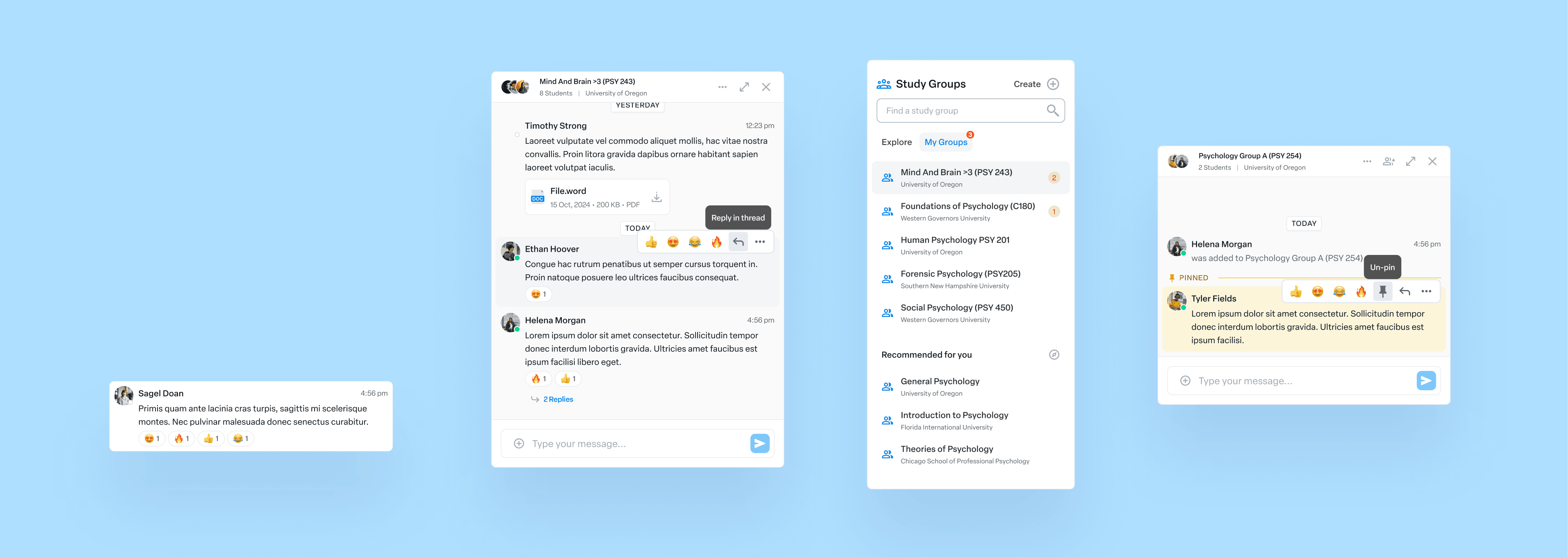
Overview
Numerade's platform thrives on providing students with valuable academic resources, yet engagement and content contributions have remained a challenge. To address this, the team proposed the feature Study Groups. This initiative was designed to offer students a collaborative environment where they could discuss academic topics, share resources, and seek support, ultimately increasing user engagement and content uploads.
Led end-to-end design for Study Groups, translating high level business and learning goals into a scalable student collaboration experience.
Owned research synthesis, experience strategy, feature prioritization, and interaction design.
Partnered closely with PM and engineering to balance learning outcomes, safety, and speed to market constraints.
Foster collaboration among students
How might we help students ask for help and learn together without creating chaos, spam, or off topic noise?
Increase active user engagement
How might we move students from passive consumption (watching answer videos) to active participation (asking, responding, sharing)?
Encourage content sharing
How might we enable sharing valuable academic materials while maintaining quality, trust, and moderation at scale?
KPIs & Measurement Strategy
Engagement
Why this mattered
Study Groups aimed to shift students from passive consumption to active learning. Without participation, the feature wouldn’t succeed.
What was measured
Daily participation in collaborative actions (messages, replies, uploads)
Average time spent in Study Groups
Why was engagement chosen?
These metrics would validate whether the design lowered the barrier to contribution and encouraged active behaviors, serving as early indicators of value before long term retention data.
Retention
Why this mattered
Study Groups needed to increase platform stickiness beyond just homework help.
What was measured
Return rate of users who joined a Study Group
Frequency of repeat participation
Why was retention chosen?
Retention would show whether collaborative learning became part of users’ regular study routines rather than a novelty.
Adoption
Why this mattered
Broad adoption was required for Study Groups to meaningfully impact Numerade’s ecosystem.
What was measured
Percentage of active users engaging with Study Groups
Feature discovery and first time interaction rates
Why was adoption chosen?
Adoption would confirm the experience was intuitive, discoverable, and valuable beyond a small power user group.

Research Inputs
Qualitative insights from student interviews and usability testing
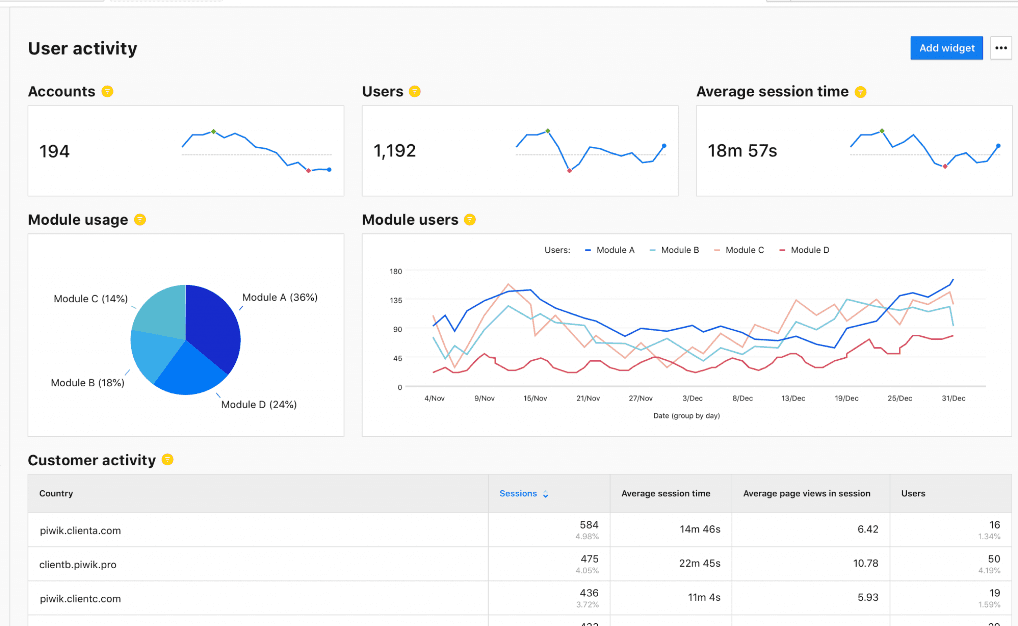
Behavioral data showing dropoffs after content consumption
Existing Numerade usage patterns (solo study, transactional Q&A)
Competitive patterns from Discord, Slack, Reddit study communities
Insight
Design Implication
Students want help now, not later →
Prioritize real time chat over async forums
Large, open groups quickly become noisy →
Start with smaller, topic based groups
Fear of asking “dumb” questions is real →
Design low friction, informal chat experiences
Trust matters when sharing notes/exams →
Strong moderation & clear group ownership needed

Competitive Patterns
Behavioral Data

Student Interviews
How Objectives translated to Features
Chat Rooms
Why?
Real time chat directly supports peer-to-peer learning and increases engagement.
Tradeoff
Accepted higher moderation complexity in exchange for faster interaction
Chose chat over threaded forums to encourage immediacy
Design Thinking
Optimized for momentum, not perfection. Learning happens fastest when friction is low.
Content Discovery & Sharing 🔍
Why?
Shared notes, lectures, and exams extend Numerade’s learning ecosystem beyond video answers.
Tradeoff
Structured sharing to prevent low-quality content dumps
Accepted slower content growth in exchange for trust and clarity
Design Thinking
Optimized for quality signals, not raw volume.
Collaboration Tools 🛠️
Why?
Students need ways to react, respond, and share without derailing conversations.
Tradeoff
Shipped a limited toolset initially instead of a full Slack style feature set
Focused on the most expressive, high signal interactions first
Design Thinking
Prioritized behavior shaping over feature completeness.
Personalization & Group Admin
Why?
Different study groups have different norms, subjects, and engagement levels.
Tradeoff
Gave admins control instead of enforcing rigid global rules
Increased complexity for group creators to improve long-term health
Design Thinking
Designed for scalability through ownership, not centralized control.
Moderation & Safety 🛡️
Why?
Open collaboration only works if students feel safe and content remains relevant.
Tradeoff
Balanced automation with human moderation tools
Avoided over policing early to prevent chilling participation
Design Thinking
Designed guardrails that protect users without discouraging contribution.
Engineering Bandwidth →
Scoped MVP features to validate behavior before expanding
Moderation Scalability →
Reused existing design system components to move faster
Existing Numerade Architecture →
Designed extensible interaction patterns that could evolve
Risk of launching an unproven feature →
Prioritized features that changed behavior, not just UI
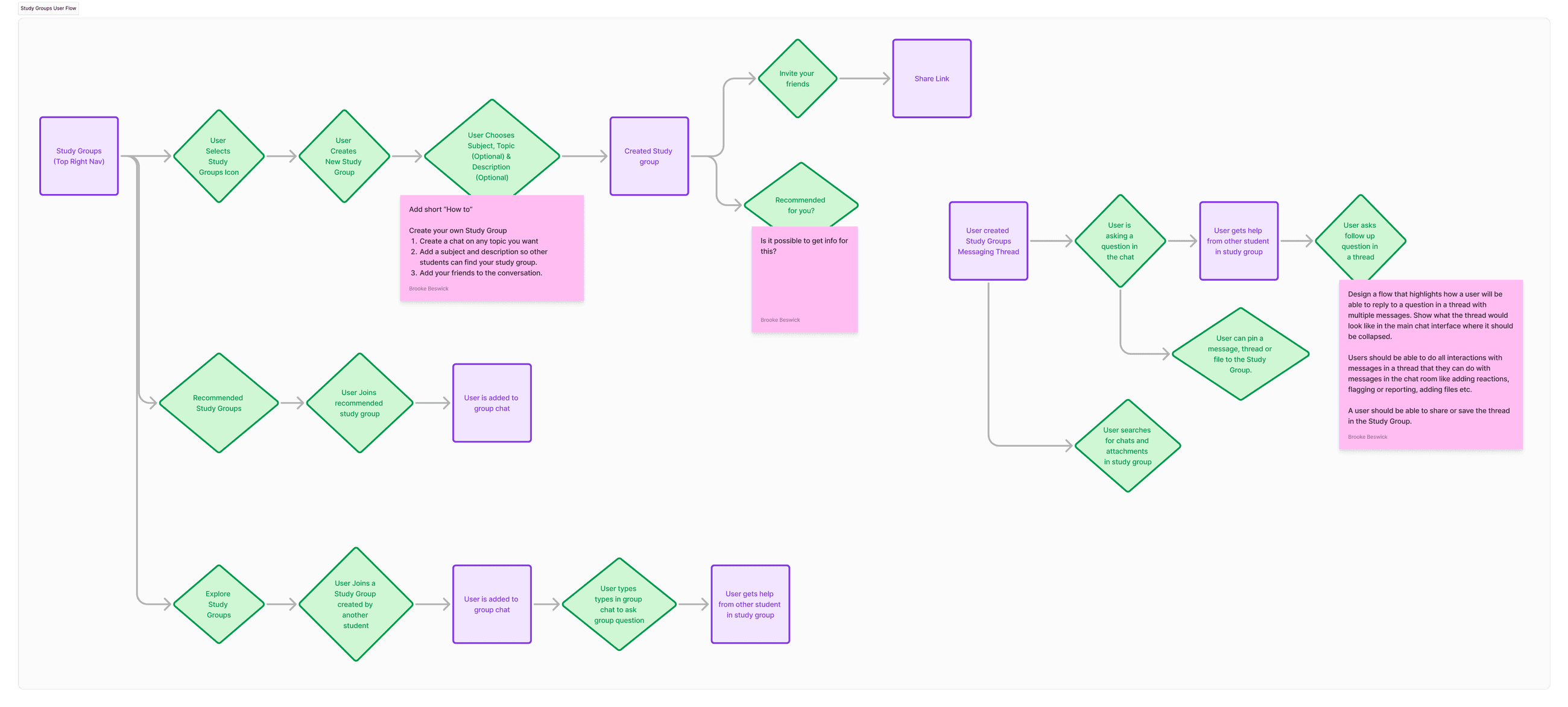
Study Groups required a scalable component system to support real-time collaboration. I designed reusable components for chat, reactions, threads, uploads, content previews, moderation, and system states, all built to integrate seamlessly with Numerade’s existing design system.
Rather than designing one-off screens, I focused on composable components that could scale across different group types, reduce future design and engineering overhead, and enable faster iteration without sacrificing consistency.
Tradeoffs & Constraints
To ship quickly and responsibly, I prioritized a focused set of interactions over feature completeness, accepted higher moderation complexity to enable real-time engagement, and optimized for extensibility rather than visual novelty. These decisions allowed us to validate core collaboration behaviors early while leaving room to evolve the system based on real usage.
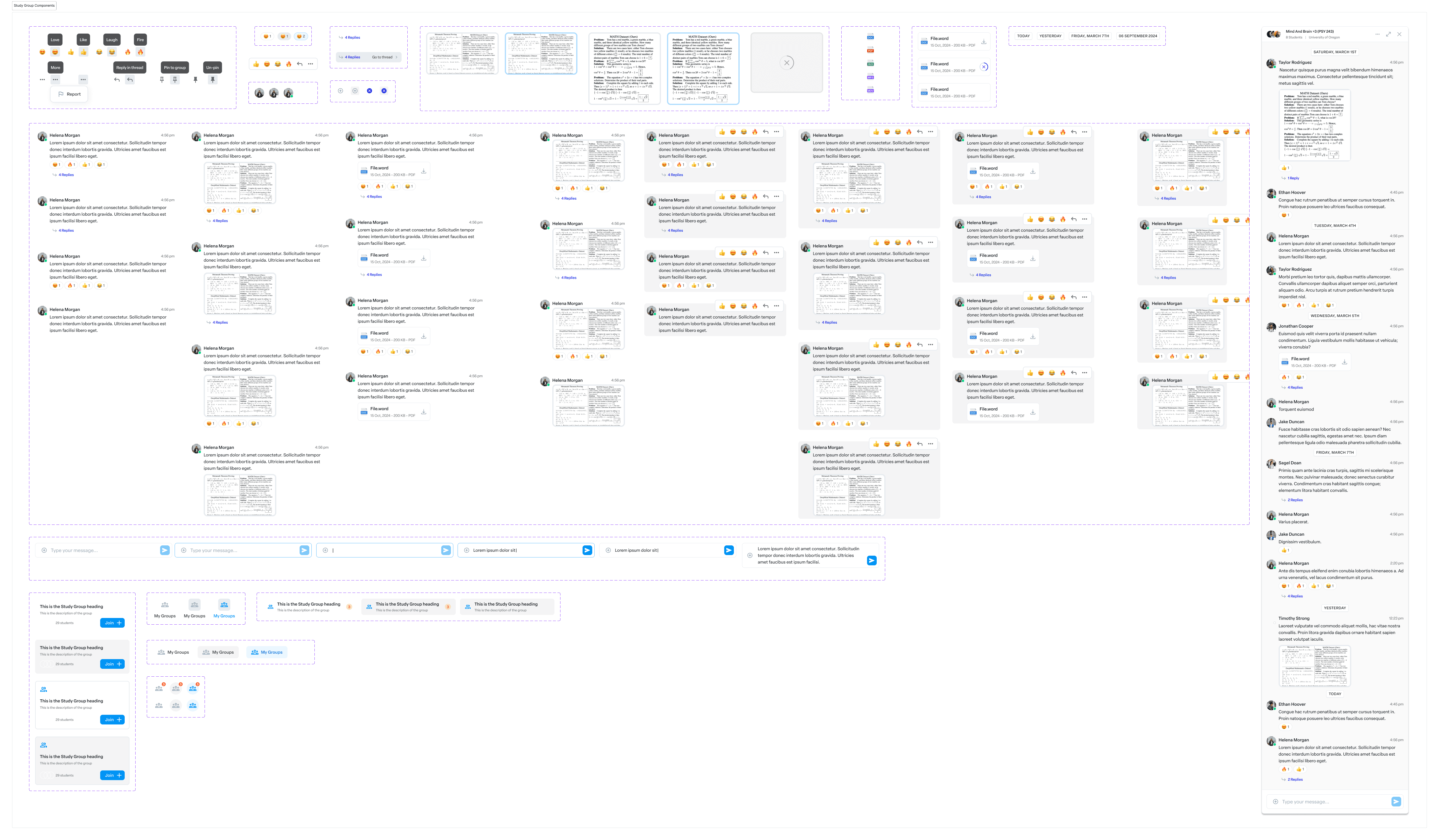
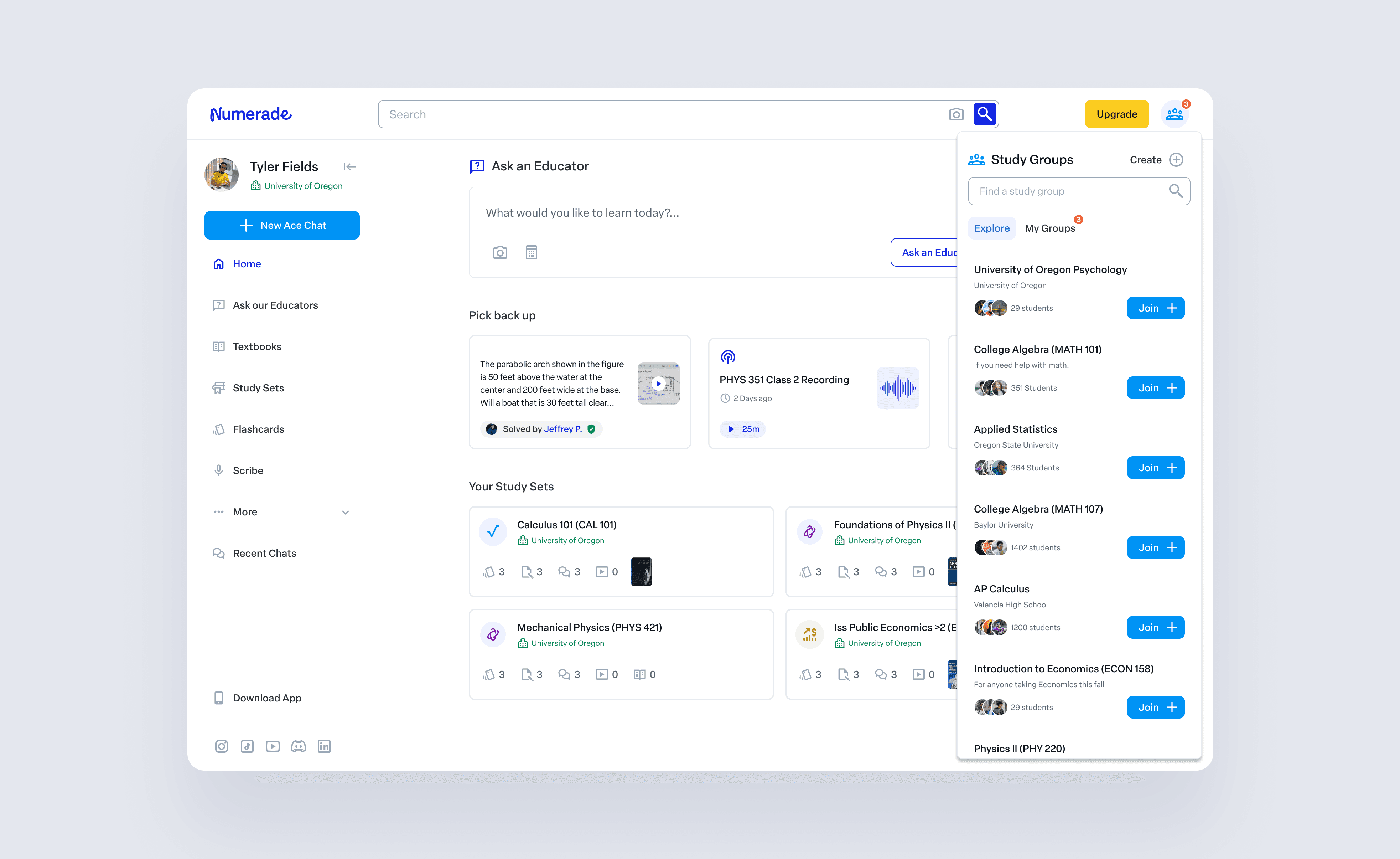
Explore Study Groups
Search Bar
Users can search for any study group by entering keywords related to subjects, topics, or group names.
Group Previews
Each result includes key details such as the group name, description and number of active members.
Join & Request Access
Daily participation in collaborative actions (messages, replies, uploads)
Average time spent in Study Groups
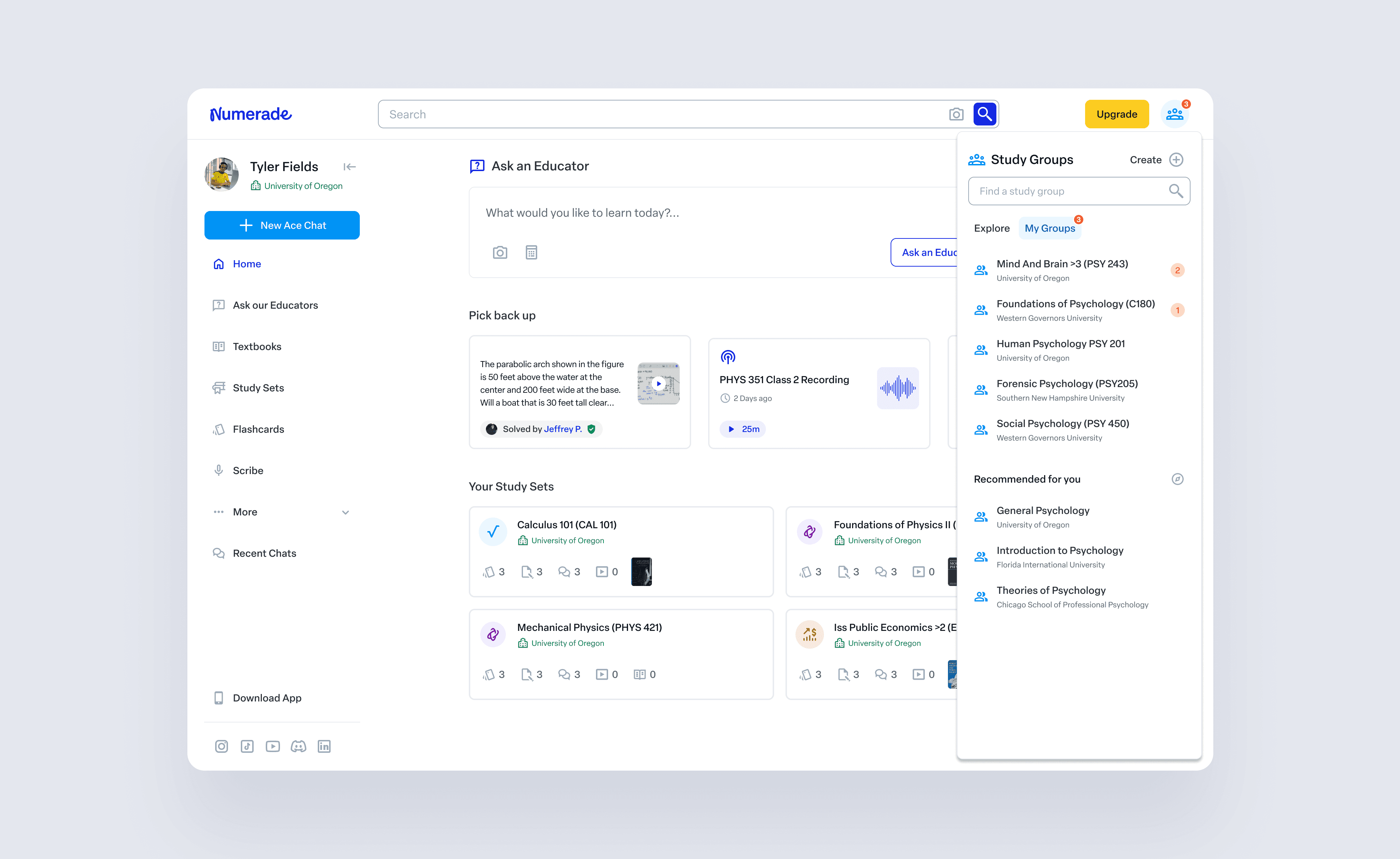
My Groups
Joined Groups
Displays all the groups a student has actively joined, sorted by recent activity to highlight ongoing discussions.
Recommended Groups
Curated suggestions based on the student’s academic interests, past participation, and trending topics within Numerade’s platform.
Messages
Message Types
Users can send text messages, images, links, and file attachments to share valuable resources and information efficiently.
Reactions
Users can react to a message with an emoji.
Reporting
Users can react to a report inappropriate content or flag/spam for moderator review.
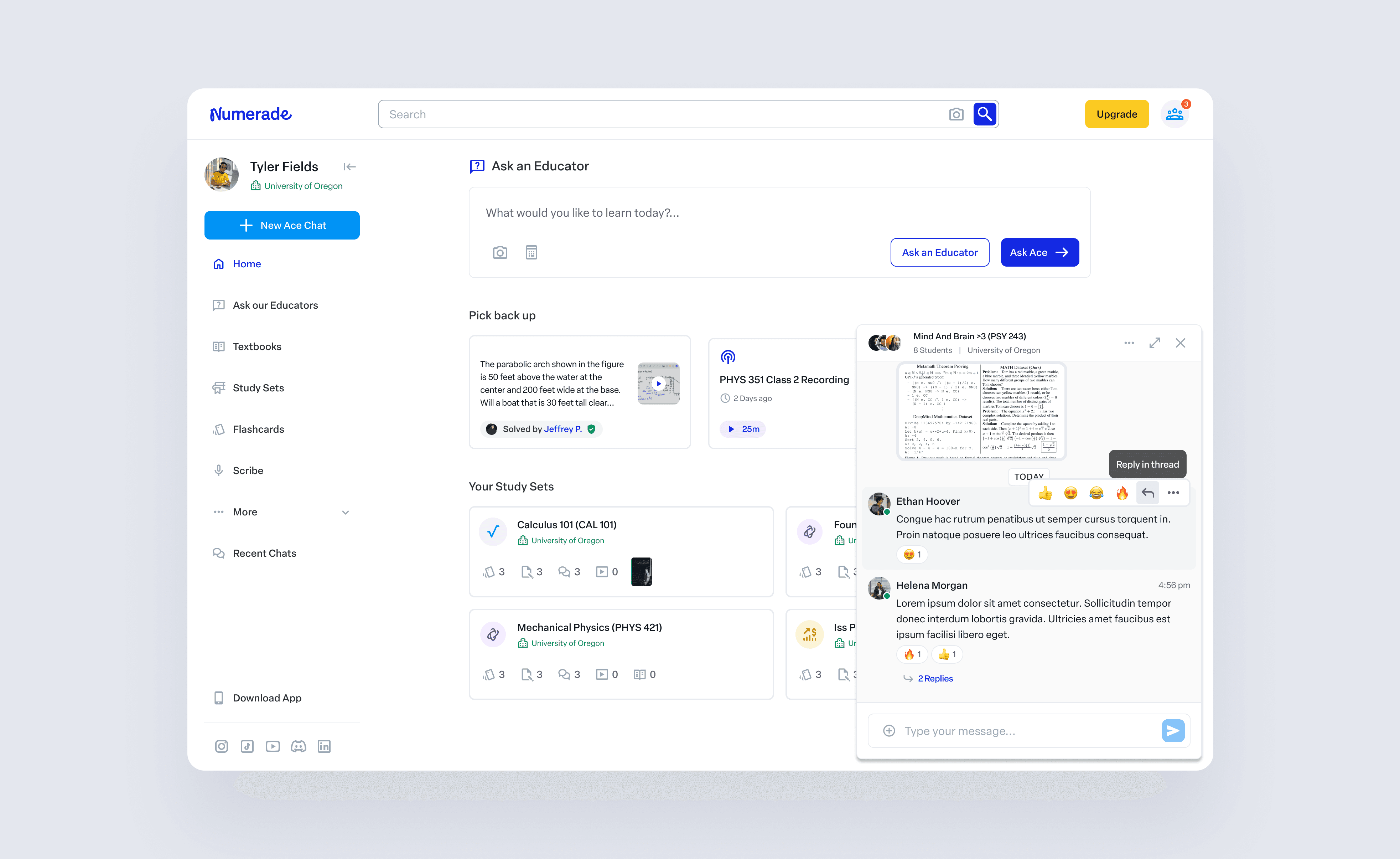
Threaded Conversations
To keep discussions organized, threaded replies allow students to respond directly to specific messages, ensuring key points are easily traceable.

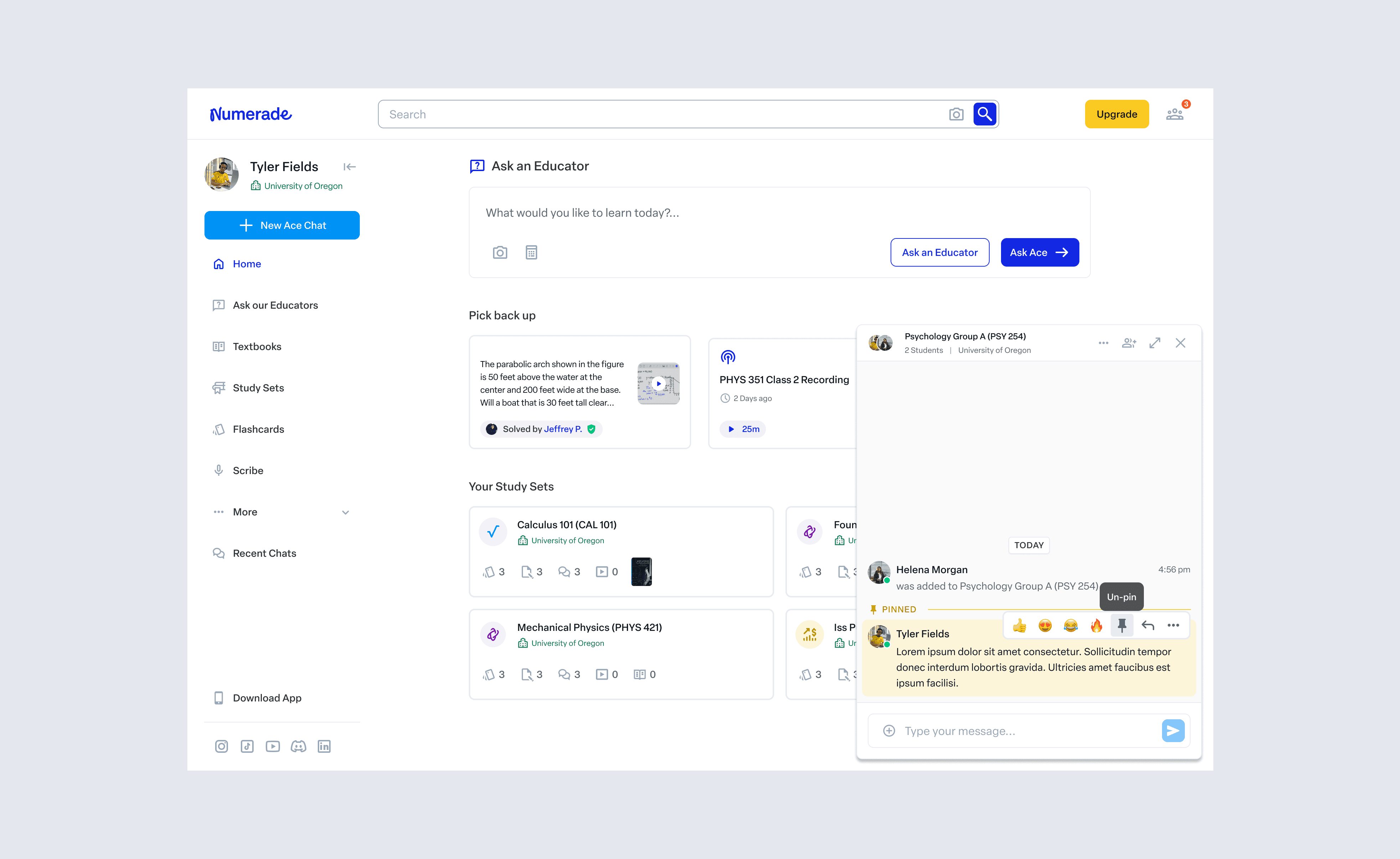
Pinned Messages
Important messages, such as exam tips, group schedules, or key files, can be pinned for easy reference.
Creating a Study Group
Start New Group
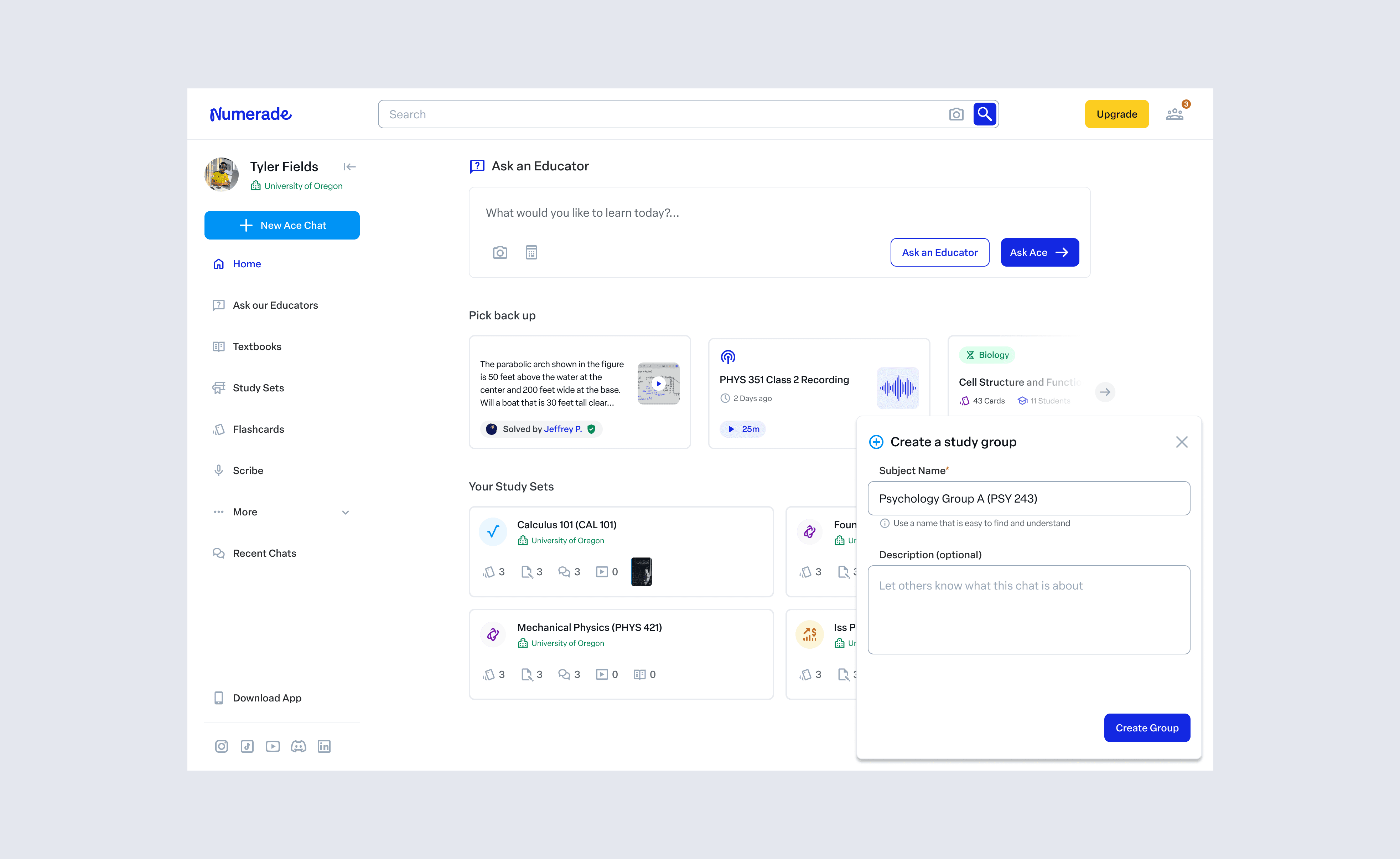
Users can initiate group creation from the "My Groups" section or directly from the Study Groups homepage.
Invite Members
Users can invite peers by sharing a direct invite link or selecting from their network within Numerade.
Engagement
Results
Average session time increased by 27%
Daily collaborative actions increased by 61%
The share of users who took at least one collaborative action grew from 22% to 40%
Reactions and threaded replies accounted for 40% of first time interactions, lowering the barrier to participation
Impact
These metrics validated that interaction-first design successfully reduced friction to contribution and encouraged sustained participation.
Retention
Results
58% of users who engaged once returned to participate again
Study Group participants showed a 20% higher 7 day return rate compared to non-participants
Engaged users averaged 1.8 Study Group sessions per week, indicating emerging habitual behavior
Impact
Retention data showed collaborative learning became part of students’ regular study routines rather than a novelty feature.
Adoption
Results
Discovery to first interaction conversion reached 38%, supported by visible peer activity and low friction entry points
31% of weekly active users engaged with Study Groups within the first release window
First time users were 1.6 times more likely to participate when groups showed recent activity
Impact
Adoption metrics confirmed the experience was intuitive, discoverable, and valuable beyond a small power user group.
Ace Integration
Embed Ace into Study Groups to summarize discussions, suggest next steps, and surface relevant content at key moments of confusion.
Shared Content Repository
Evolve uploads into a searchable group library so high quality notes and resources persist beyond real time chat.
Poll, Surveys & Gamification
Introduce low friction ways to prioritize topics, encourage participation, and reinforce helpful behaviors without incentivizing noise.
Conclusion
This project reinforced how I approach product design, to start with behavior, not features. By designing interaction first systems within real constraints, I helped shift Study Groups from passive content consumption to active collaboration, driving meaningful engagement and repeat use for Numerade.



" height="512px" id="xSuhzR5c2" width="512px"/><path d="M 128 256 C 198.692 256 256 198.692 256 128 C 256 57.308 198.692 0 128 0 C 57.308 0 0 57.308 0 128 C 0.148 198.631 57.369 255.852 128 256 Z M 128 232.691 C 106.784 232.717 86.074 226.214 68.682 214.063 C 87.705 186.957 114.65 166.402 145.819 155.217 C 153.19 178.611 157.846 202.776 159.697 227.234 C 149.478 230.683 138.784 232.524 128 232.691 Z M 181.895 217.263 C 179.649 194.049 175.033 171.125 168.118 148.851 C 188.709 144.742 209.91 144.742 230.501 148.851 C 224.529 177.427 206.914 202.219 181.895 217.263 Z M 232.421 125.642 C 208.503 121.23 183.949 121.585 160.168 126.686 C 157.204 119.074 154.038 111.596 150.535 104.185 C 171.23 91.757 189.288 75.392 203.688 56.017 C 221.594 74.843 231.839 99.667 232.421 125.642 Z M 128 23.309 C 148.619 23.262 168.786 29.347 185.937 40.792 C 173.556 57.903 157.934 72.415 139.958 83.503 C 128.77 63.501 115.565 44.697 100.547 27.385 C 109.475 24.808 118.708 23.437 128 23.309 Z M 77.912 36.581 C 93.759 54.155 107.599 73.44 119.175 94.08 C 89.882 106.583 57.535 110.1 26.24 104.185 C 33.085 75.337 51.871 50.758 77.912 36.581 Z M 55.781 130.897 C 81.32 130.812 106.56 125.397 129.886 114.998 C 132.817 121.128 135.444 127.158 137.937 133.524 C 103.079 145.994 72.815 168.73 51.133 198.737 C 33.258 179.518 23.318 154.247 23.309 128 C 34.058 129.655 44.907 130.578 55.781 130.762 Z" fill="rgb(255, 255, 255)" height="256px" id="yz5C7HgZH" transform="translate(128 128)" width="256px"/></g></g></svg>)
" height="512px" id="ODVqMaewa" width="512px"/><g d="M 69.929 34.931 C 69.943 49.078 61.429 61.84 48.361 67.26 C 35.293 72.681 20.246 69.692 10.242 59.688 C 0.238 49.684 -2.751 34.637 2.669 21.568 C 8.089 8.5 20.851 -0.014 34.999 0 C 54.283 0.019 69.911 15.647 69.929 34.931 Z M 16.607 256 C 11.826 256 7.95 252.124 7.95 247.343 L 7.95 93.103 C 7.95 88.322 11.826 84.446 16.607 84.446 L 53.39 84.446 C 58.172 84.446 62.047 88.322 62.047 93.103 L 62.047 247.343 C 62.047 252.124 58.172 256 53.39 256 Z M 254.35 173.373 L 254.35 248.051 C 254.35 252.441 250.791 256 246.401 256 L 206.923 256 C 202.533 256 198.974 252.441 198.974 248.051 L 198.974 175.697 C 198.974 164.884 202.106 128.539 170.746 128.539 C 146.426 128.539 141.475 153.533 140.43 164.749 L 140.43 248.219 C 140.34 252.517 136.848 255.965 132.548 256 L 94.35 256 C 92.239 256.009 90.212 255.174 88.719 253.682 C 87.227 252.189 86.392 250.162 86.401 248.051 L 86.401 92.429 C 86.392 90.315 87.226 88.285 88.717 86.787 C 90.209 85.288 92.236 84.446 94.35 84.446 L 132.548 84.446 C 134.689 84.41 136.754 85.235 138.281 86.736 C 139.807 88.237 140.667 90.289 140.666 92.429 L 140.666 105.903 C 149.694 92.429 163.1 81.92 191.63 81.92 C 254.721 81.886 254.35 140.935 254.35 173.373 Z" fill="transparent" height="256.00007702350763px" id="ijXxm5OgS" transform="translate(128.807 128)" width="254.35054327352088px"><path d="M 69.929 34.931 C 69.943 49.078 61.429 61.84 48.361 67.26 C 35.293 72.681 20.246 69.692 10.242 59.688 C 0.238 49.684 -2.751 34.637 2.669 21.568 C 8.089 8.5 20.851 -0.014 34.999 0 C 54.283 0.019 69.911 15.647 69.929 34.931 Z" fill="rgb(255, 255, 255)" height="69.92944321850571px" id="s2hvQbaZZ" transform="translate(0 0)" width="69.92944321850572px"/><path d="M 8.657 171.554 C 3.876 171.554 0 167.678 0 162.897 L 0 8.657 C 0 3.876 3.876 0 8.657 0 L 45.44 0 C 50.221 0 54.097 3.876 54.097 8.657 L 54.097 162.897 C 54.097 167.678 50.221 171.554 45.44 171.554 Z" fill="rgb(255, 255, 255)" height="171.5536842105263px" id="S5MPGmwH9" transform="translate(7.95 84.446)" width="54.096842105263164px"/><path d="M 167.95 91.453 L 167.95 166.131 C 167.95 170.521 164.39 174.08 160 174.08 L 120.522 174.08 C 116.132 174.08 112.573 170.521 112.573 166.131 L 112.573 93.777 C 112.573 82.964 115.705 46.619 84.345 46.619 C 60.025 46.619 55.074 71.613 54.03 82.829 L 54.03 166.299 C 53.939 170.597 50.447 174.045 46.147 174.08 L 7.95 174.08 C 5.838 174.089 3.811 173.254 2.318 171.762 C 0.826 170.269 -0.009 168.242 0 166.131 L 0 10.509 C -0.009 8.395 0.825 6.365 2.316 4.867 C 3.808 3.368 5.835 2.526 7.95 2.526 L 46.147 2.526 C 48.288 2.49 50.353 3.315 51.88 4.816 C 53.406 6.317 54.266 8.369 54.265 10.509 L 54.265 23.983 C 63.293 10.509 76.699 0 105.23 0 C 168.32 -0.034 167.95 59.015 167.95 91.453 Z" fill="rgb(255, 255, 255)" height="174.0800864839568px" id="PbgTI7r9W" transform="translate(86.401 81.92)" width="167.94959570272007px"/></g></g></g></svg>)